
Beyond Burnout: The 5-Second Neuroscience Trick for Lasting Mental Clarity
You're a high achiever. You meet deadlines, exceed expectations, and maintain an image of complete control. Yet, behind the external success, there's a different story: a constant, low-grade hum of stress, a pervasive brain fog that clouds your focus, and an emotional friction that makes every interaction feel like an effort. You've tried everything—mindfulness apps, productivity hacks, even therapy—but nothing seems to create a lasting shift. What if the problem isn't your mindset, your willpower, or your discipline? What if the issue is deeper, rooted in your very own biological 'signal'?
The Real Culprit: Understanding 'Signal Compression'
The relentless pace of modern life, with its constant pings, notifications, and demands for our attention, has a direct neurological consequence. At CELF, we call this 'signal compression.' Imagine your capacity for awareness and emotional experience as a wide, open landscape. Signal compression is the process where that landscape is relentlessly squeezed, narrowing your perceptual and emotional range. Your nervous system, forced into a state of high alert, begins to operate within a much tighter bandwidth. The result? You become more reactive, your thinking becomes rigid, and you feel perpetually drained. This isn't a personal failing; it's a biological response to an overstimulated environment. Burnout, fatigue, and that feeling of being perpetually overwhelmed are the direct symptoms of a compressed internal signal.

The 'Signal Shift': A 5-Second Micro-Practice for Immediate Relief
If the problem is biological, the solution must be too. The key isn't to force a change through willpower, but to introduce a new, corrective signal to your nervous system. This is possible through a principle called 'microplasticity'—the idea that brief, frequent, and precisely timed inputs can create significant and lasting neurological change. You don't need an hour of meditation; you need a 5-second reset, integrated into the habits you already have.
Here’s a simple, science-backed micro-practice you can start today. Anchor it to one of the most common actions you take: unlocking your phone.
-
**Pause:** The moment you pick up your phone to unlock it, stop. Before your thumb touches the screen, take a deliberate pause.
-
**Perceive:** Briefly shift your attention to your physical senses. Notice the feeling of the phone in your hand, the temperature of the air, or a sound in the distance. This takes only a second or two.
-
**Proceed:** Unlock your phone and continue.
This simple act interrupts the automated reactive loop. It’s a 2-to-5-second intervention that sends a powerful signal to your nervous system, telling it to decompress and widen its 'range.' By converting a digital interruption into a training trigger, you begin to reclaim your internal sovereignty.

From Micro-Habit to Macro Change: Achieving Predictable Control
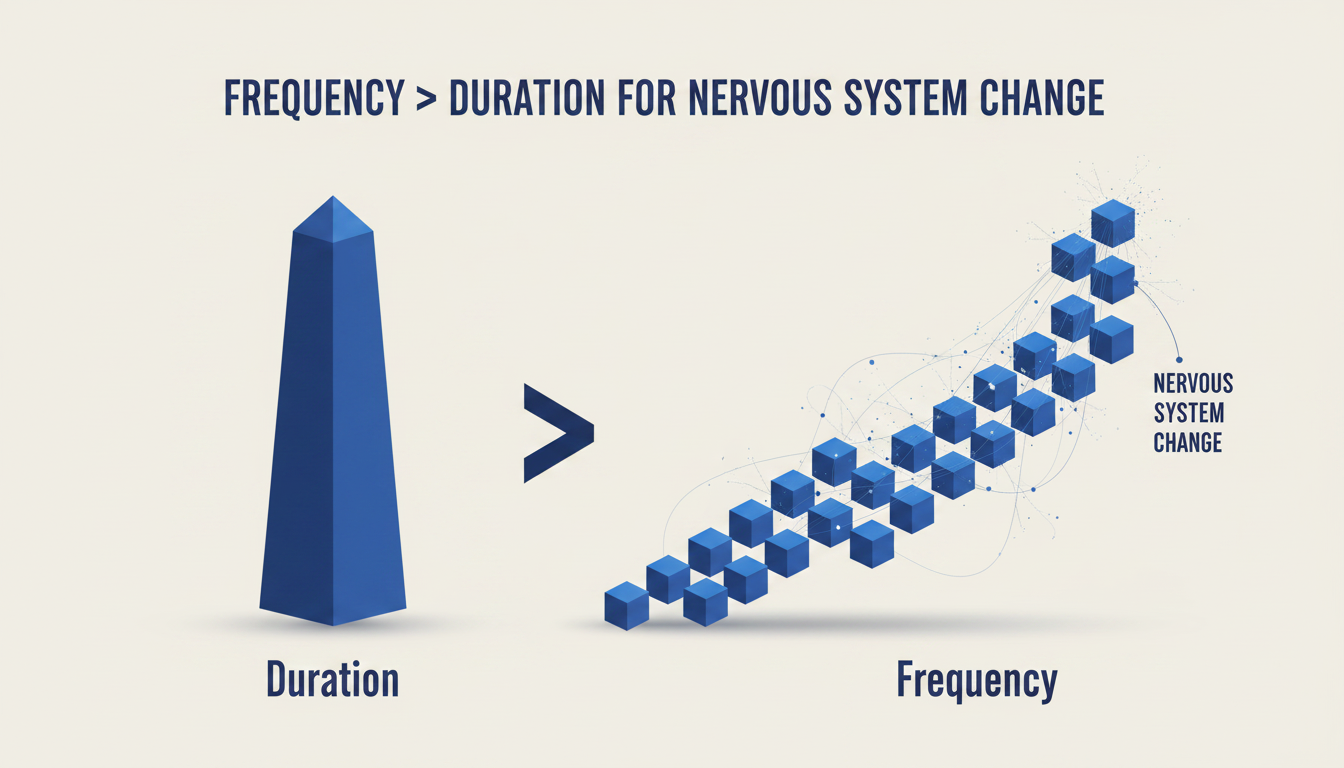
It might feel counterintuitive that something so brief could be effective, but the power lies in frequency, not duration. Rewiring your nervous system is like learning a new language; practicing for one minute, sixty times a day, is far more effective than practicing for one hour, once a day. Each 5-second 'Signal Shift' is a rep for your nervous system, building a new baseline of calm and clarity over time.
This is how you move from merely coping with stress to gaining predictable control over your internal state. When you perform hundreds of these micro-resets each week, you are fundamentally changing the signal that shapes your perception. The result is exactly what high-achievers are searching for: measurable relief from chronic stress, the ability to maintain higher clarity under pressure, and a sustained sense of calm that isn't dependent on external circumstances. You're no longer just managing your day; you're managing your biology.
Conclusion: Stop Managing Symptoms, Start Mastering Your Signal
True sovereignty—the genuine authorship of your own experience—doesn't come from another productivity app or from forcing yourself to 'think positive.' It comes from intervening at the most fundamental level: your internal signal. By understanding the concept of signal compression and using targeted micro-practices to counteract it, you can move beyond the endless cycle of burnout and recovery. You can stop managing symptoms and start mastering the very system that creates them.
If you're ready to move from a reactive life to one of conscious authorship, it's time to learn the science of feeling. Discover the complete CELF system and gain the tools to achieve a fundamental, lasting shift in your well-being and performance. Your full human range is waiting to be reclaimed.
Leave a Reply