
You've checked all the boxes of success: the title, the responsibilities, the results. Yet, behind the polished exterior, there's a constant internal friction. You feel a persistent sense of activation, a mental fog that clouds your best thinking, and an irritability that shortens your fuse. You've tried mindfulness apps, productivity hacks, and maybe even therapy, but the relief is always temporary. It feels like you're only managing the symptoms of a deeper issue, a hidden 'upstream' problem that no amount of coping seems to fix. This isn't a failure of discipline; it's a sign that you're addressing the wrong problem.

The Root Cause: Unpacking 'Signal Compression' in a High-Pressure World
The relentless pace of modern professional life—the constant pings, back-to-back meetings, and the pressure to always be 'on'—has a direct biological consequence on your nervous system. This state of chronic over-activation leads to what neuroscience calls 'Signal Compression.' Essentially, your brain and body, in an attempt to manage the information overload, narrow your perceptual and emotional bandwidth. Your ability to see the bigger picture shrinks, your emotional responses become more rigid and reactive, and your capacity for creative, strategic thought diminishes. This isn't a psychological shortcoming; it's a predictable physiological adaptation to an unsustainable environment. Your system is stuck in a compressed, low-range state, making stress and brain fog your default operating mode.
Beyond Coping: The Critical Shift from Managing Symptoms to Changing the Signal
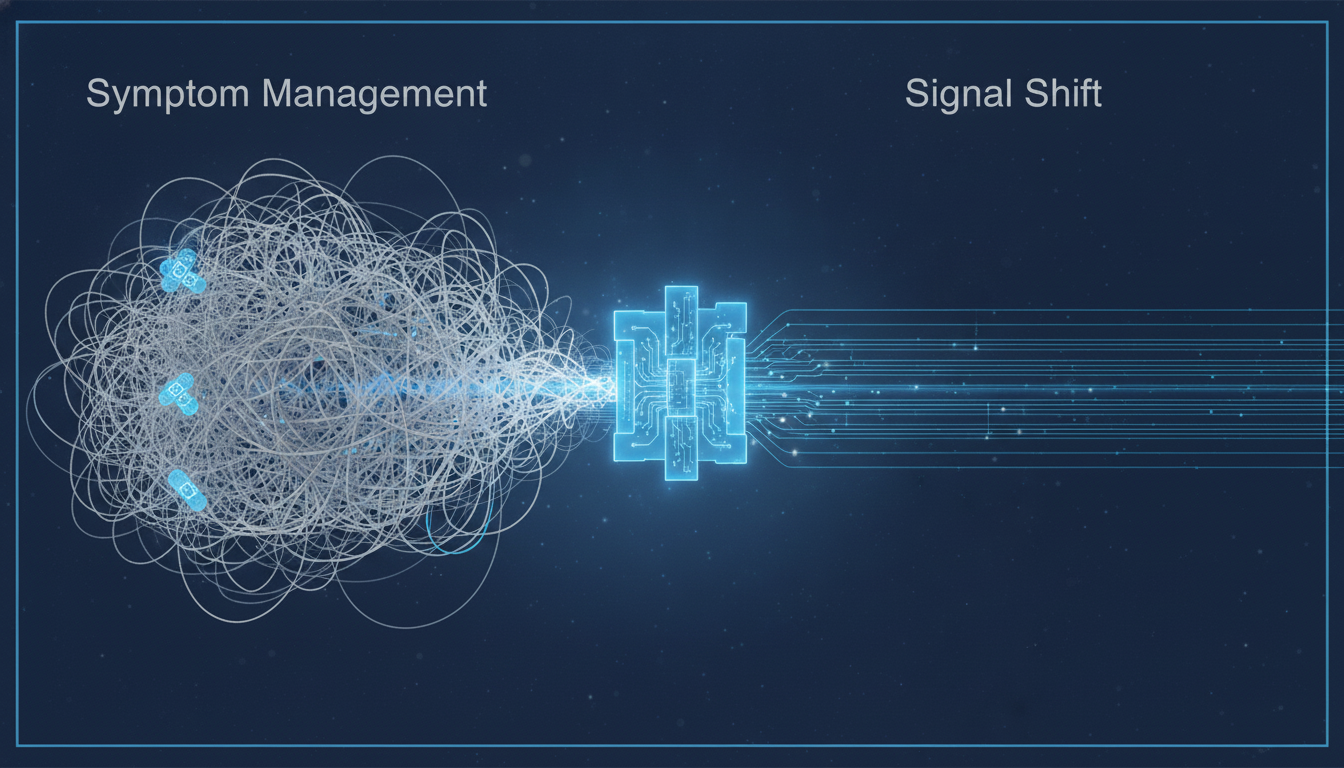
Most stress-management techniques are designed to help you cope with the effects of compression. Deep breathing, meditation, and taking breaks can provide temporary relief, but they don't address the underlying signal that's keeping you stuck. They are downstream solutions for an upstream problem. The CELF methodology, Signal Shift, represents a fundamental departure from this model. Instead of just managing the emotional and cognitive symptoms, it intervenes at the source. It works to directly re-calibrate the fundamental neurological signal that dictates your internal state. By changing the signal itself, you move from a reactive state of coping to a proactive state of control, making clarity and composure your new baseline, even under pressure.
The 5-Second Reset: How 'Microplasticity Routines' Restore Predictable Control
Fixing the root signal doesn't require hours of meditation or a retreat from your demanding schedule. The solution lies in leveraging your brain's own capacity for change—neuroplasticity—through brief, targeted interventions. Microplasticity Routines are 2- to 5-second nervous system resets designed to be deployed frequently throughout your day. These aren't just another thing to add to your to-do list; they are designed to be triggered by the digital interruptions you already experience, like unlocking your phone or opening a new tab. Each tiny reset counteracts signal compression, progressively widening your perceptual and emotional range. This high-frequency training provides immediate, measurable relief and restores predictable control over your internal state, seamlessly integrating advanced self-regulation into the fabric of your busiest days.

Reclaim Your Sovereignty for Peak Performance
Ultimately, the goal is to transition from being a reactor to your circumstances to becoming the conscious author of your experience—a state we call 'sovereignty.' When you can reliably regulate your internal signal, you gain true command over your cognitive and emotional resources. For the high-achiever, this translates directly into a competitive advantage: sustained clarity under intense pressure, a dramatic reduction in brain fog, faster cognitive recovery, and the ability to make better decisions. The constant, draining battle with internal stress is replaced by a calm, focused presence. It's time to stop merely coping with the symptoms of a broken system and start mastering the internal signal that drives your performance.
If you're tired of the cycle of stress and temporary fixes and are ready to achieve a lasting, identity-level shift in your well-being and performance, it's time to learn how to correct the signal at its source. Discover the neuroscience-consistent methodology that gives you predictable control over your internal state, allowing you to unlock your full human range and potential. Explore the Signal Shift system and begin your journey from reactivity to true sovereignty.
Leave a Reply